
The Importance of Human-Grade Food for Your Dog's Health and Behavior Why Feed Human-Grade Dog Food

Updated: May 1
Week after week I meet pet parents asking about their pups behavior but they also want to know why their dog is itching, anxious, overweight, under-muscled, or simply “not right.” Food is almost always part of that equation.
Here are the 4 most common questions I seem to be answering on repeat as to why human-grade feeding is the direction you may want to try with your pup.

1. “Is human-grade dog food actually better, or is it just marketing?”
Short answer: some of it is marketing—but the standard itself matters. “Human-grade” means every ingredient is legally fit for human consumption and processed under human food safety standards. That’s a completely different supply chain than feed-grade pet food, which can include lower-quality byproducts, rendered materials, and inconsistent sourcing. What that translates to in practice:
Cleaner protein sources → better muscle tone, less inflammation
Fewer unknowns → fewer digestive and skin reactions
Higher bioavailability → your dog actually uses what they eat
Most dogs don’t need more food—they need food their body can recognize and utilize efficiently.
2. “Why does my dog act different when I change food?”
Because behavior is not separate from physiology. Food directly impacts:
Nervous system regulation
Gut-brain signaling
Blood sugar stability
Inflammatory load
If a dog is:
reactive
unable to settle
constantly stimulated
struggling with impulse control
…it is not just training. It’s internal state. Lower-quality diets—especially those high in fillers, unstable fats, and synthetic additives—can dysregulate a dog’s system. You’ll see it as:
restlessness
poor focus
erratic energy
When you move to a cleaner, human-grade structure, many dogs:
settle faster
think more clearly
hold behavior under pressure
Training sticks better because the nervous system isn’t fighting you.
3. “Do I need to worry about synthetic vitamins?”
This is where most people get tripped up. Synthetic vitamins are not inherently “bad”—they’re often used to meet minimum nutritional standards. The issue is why they’re needed in the first place.
If a food requires heavy synthetic supplementation, it usually means:
the base ingredients are nutritionally depleted
processing has destroyed natural nutrient content
the formula relies on lab reconstruction rather than whole-food integrity
Higher-quality human-grade foods rely more on:
real organ meats
whole food micronutrients
minimally processed structures
That creates a more balanced, biologically familiar nutrient profile.
Your dog’s body doesn’t just need nutrients—it needs them in a form it recognizes.
AND THE MOST IMPORTANT QUESTION!!!!!
4. “Is this really worth the cost?”
Blunt answer: it depends on what you’re comparing it to.
If you’re comparing it to cheap kibble—yes, it’s more expensive upfront.If you’re comparing it to:
chronic vet visits
skin issues
behavioral frustration
supplements to “fix” deficiencies
…it often evens out.
What we consistently see:
improved coat and skin (less itching, less shedding)
better stool quality (a sign of absorption, not just digestion)
leaner body composition without calorie restriction
reduced reactivity and more stable behavior
You’re not just buying food—you’re reducing downstream problems.
Why We Chose Human-Grade Feeding
Because we don’t separate:
behavior from biology
training from physiology
performance from nutrition
A dysregulated dog cannot consistently perform, no matter how skilled the training.
Human-grade feeding gives us:
predictability in how dogs respond
consistency in energy and focus
stability in the nervous system
That’s what allows real-world behavior to hold—not just in a session, but in life.
Bottom Line
If your goal is:
calm, reliable behavior
a dog that can think under pressure
long-term health instead of symptom management
…food is not optional—it’s foundational.
You can train around poor nutrition for a while.Eventually, it catches up. Or you build from the inside out—and everything gets easier.
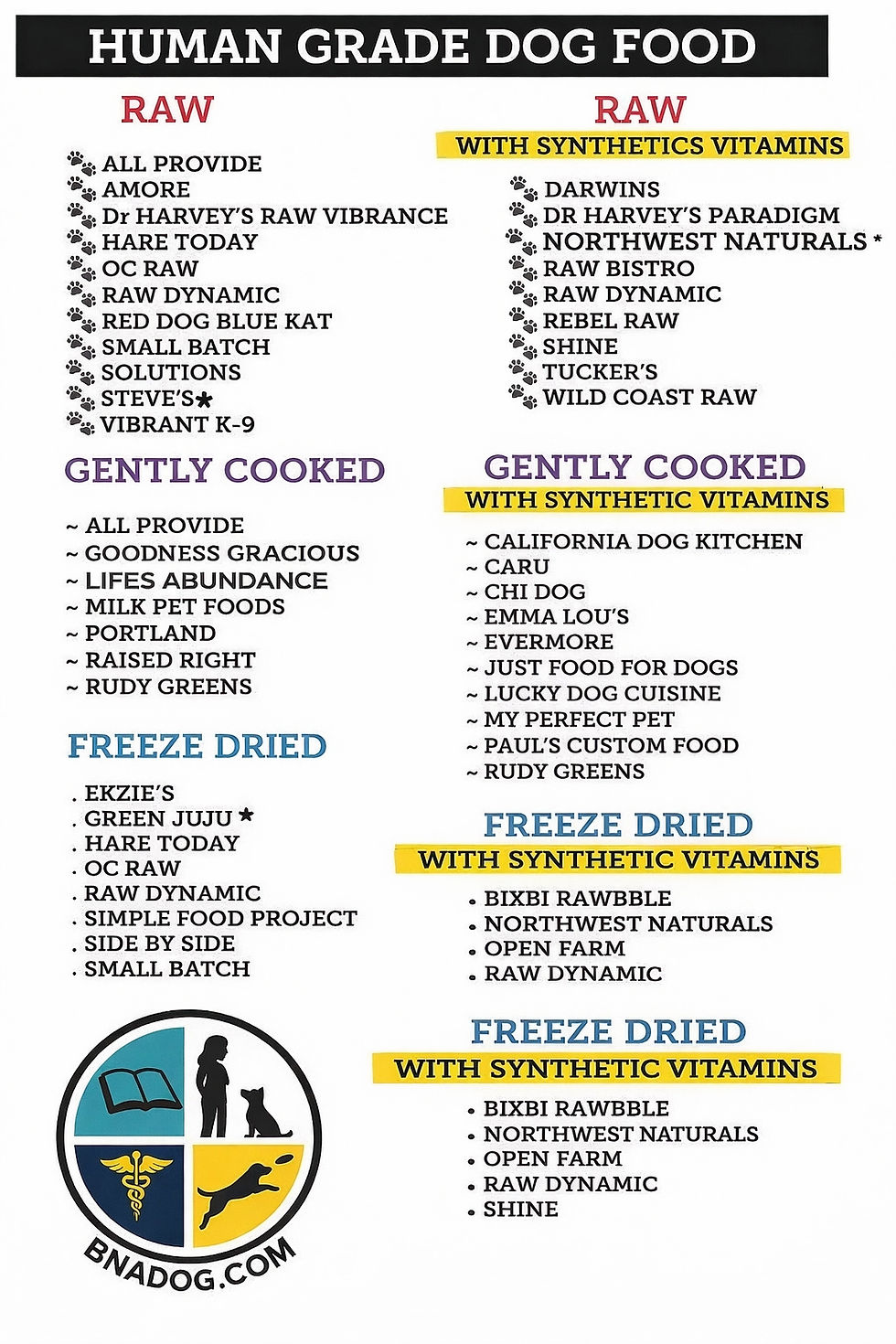
Here is my suggested list. If you want more information, details or a private consultation reach us at 8603041447.



Comments