
Animal Behaviorist on Being a Trainer animal-behavior-training-relationships

Animal Behaviorist on Being a Trainer This weather has me thinking about dogs and puppies and how they come attached to humans. That is the part most people do not always understand about dog training. I may be called in for the dog, but the human part of the equation is where I spend most of my time teaching, translating and observing.
Consultations are not just about showing a dog what to do. They are about teaching owners to understand how dogs learn, how dogs perceive interaction, and how we can train in a way that makes sense to the dog in front of us. When I demonstrate an exercise, I am always watching two learners at once. The dog and the human.
The dog may be following a lure, changing posture, softening, engaging, offering repeated right answers and clearly enjoying the success. The human may only see, “She is just giving treats.” But that is not what is happening. What is happening is connection. Direction. Timing. Repetition. Reinforcement. The dog is learning through movement, clarity and success. The dog is having fun because the exercise makes sense and because the answer is available. That is training. animal-behavior-training-relationships
For many people, it is foreign to walk into a room and scan it the way a trainer does. Most people do not naturally notice the small details. The dog’s posture. The handler’s posture. Tension in the leash. A shift in weight. A pause. A look away. A sudden burst of excitement. A change in breathing. A dog trying to figure out what is safe, what is rewarding and what is expected. Many people also do not realize how their own body posture, movement, frustration, speed or hesitation affects the dog. Slowing down enough to understand what the dog is perceiving can be very hard, but it is vital.
Humans can be resistant to change. Resistant to learning something new. Resistant to letting go of prior experiences, prior beliefs or prior success with other dogs. Some people think I am judging them. Some are afraid to be wrong. Some are afraid to rewrite how they think about dogs. Some are attached to “what worked before.” Some are embarrassed that they need help at all. That resistance shows up in many ways.
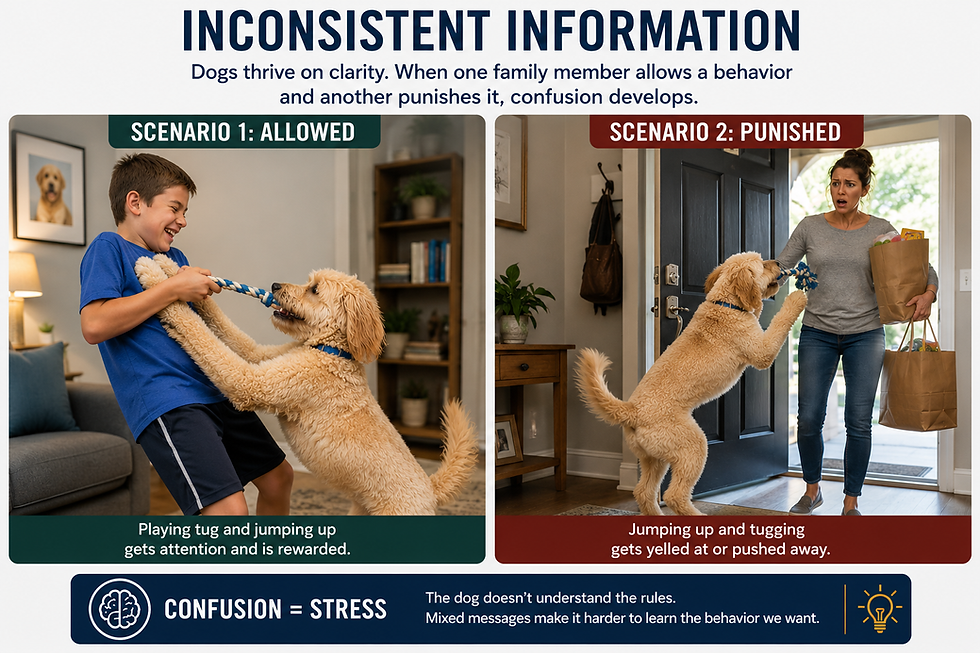
A client may say, “I do not mind if the dog jumps on me. I just do not want him jumping on strangers.”
That is where we slow down. Because the dog does not automatically understand that distinction. Dogs do not learn from our private exceptions. They learn from patterns, repetition and consequences. Sometimes I think people were never given patience themselves. They were never taught in a way that helped them learn. Most of us went to school and were expected to sit still, listen and get the right answer. If we got it wrong, we got an X. But if someone gets the answer wrong, that usually means the concept is out of reach, the steps need to be broken down or the teaching style needs to change. It does not mean the student is stupid, slow or difficult. Imagine if instead of being told you were wrong, shamed, corrected or made to feel not good enough, your teacher took the time to teach you in the way you actually learn. That is what dogs need.
Dogs are kinesthetic learners. They learn through movement, repetition, timing, reward, consequence, environment and doing. They are not sitting in a classroom taking notes. If you are trying to teach your dog the way you were taught in school, it is probably going to fail. Rather than teaching through punishment, we can use play, reinforcement, structure and success. We can teach alternate behavior. Alternate
behavior matters.
Your dog sees another dog walking past the house. The dog instinctively gets excited, alerts and starts warning you that someone is there. That is not spite. That is not defiance. That is instinct. It is written into the dog’s genetic code.
So the question becomes, how do we allow the dog to be a dog while also teaching them what else to do?
We have to teach something before we can ask for something. That is why many dogs begin with a default sit. It is simple. It is useful. It can be proofed in the house, outside, at the door, near distractions and out in the real world. Once the dog understands it, we can ask for something different instead of just reacting to what we do not want.
That is a basic example, but the principle is huge. There is a lot of science, timing and skill behind applying this in different situations, especially when we are working with reactivity, arousal, frustration, fear or overstimulation. Imagine if your teacher taught you in a way you could understand instead of punishing you for not understanding.
That is what I want for your dog. It is fun. It is engaging. It builds relationship. You and your dog become a team. You move through space together. Many people walk down the street on their phones while the dog is left to do whatever. Then when the dog sees a squirrel, another dog or a person, they expect instant connection and control.
But connection does not magically appear during the crisis. It is built before the squirrel. Dogs are constantly reading incongruence. They notice what we do, not just what we say. When owners are talking, yelling, tugging, maneuvering, rushing or becoming impatient, it affects how the dog perceives them. The dog may become confused. The dog may lose trust. The dog may stop having fun. It becomes a mismatch.
That is not always the case. Most of the time, it is a love fest. We love our dogs and our dogs love us. But when there is real misalignment, I often hear things like, “He is being defiant,” “He is spiteful,” or “She knows better.”
Humans are wired to make stories. We often put our own traits, frustrations and struggles onto the dog. Sometimes the dog becomes the place where people project the things they dislike in themselves or fear others will judge in them. I hear people call their dogs names. I see people ridicule themselves in the same breath. There is often a connection between harsh self talk, fear of judgment and harsh interpretations of the dog. People who are hard on themselves often need more kindness and more guidance when working with their pups. There is a direct correlation between difficult human relationships and difficult canine relationships. Not always, but often enough to pay attention. Many people have had many dogs. Then this one dog comes along and changes everything. That dog is often a blessing, even when it does not feel like one. That dog puts eyes on how we move through space, how we perceive the world, how we handle frustration, how we communicate, where we trust and where we do not.
Some people are naturally able to observe body language. They read emotional states without even realizing it. They notice mood, tension, discomfort, hesitation and changes in behavior. Training enhances those skills so we become sensitive to the subtlest shifts in the dog. Because dogs come attached to humans, trainers also become sensitive to human body language and emotional states. We notice when people are unhappy, annoyed, tense, embarrassed, resistant, overwhelmed or shut down. A good trainer has to teach the dog and the human without offending either one. That takes skill.
We meet a huge range of personalities. Some people are there under duress because a spouse, parent or family member insisted the dog needed training. Some do not think training is necessary. Some trained with old school methods in the past and resent “treat training,” but attend anyway. Some have physical limitations or emotional challenges and need careful, gentle handling. Some want to train their dogs but do not really want instruction because they already have their own ideas. Some are in denial about the dog’s behavior. Some are inconsiderate of other people or other dogs. Some got a dog to “teach the child responsibility.” Some want help, but do everything possible to avoid doing the work. Then there are the people who understand the value of training. The people who love their dogs and want to meet their needs. The people who respect the process. The people who trust guidance. The people who stay for years because it is fun and because the bond with their dog keeps growing. Those are the clients who keep us going. Being a trainer requires resilience. I may plan to teach a progression of exercises, but if the foundation work was not practiced, there is no progression. We adjust. We meet the dog and the human where they are that day.
Sometimes the owner is frustrated because they spent the money and the issue is not magically resolved. This is where we talk about management versus behavior change.
Management keeps everyone safe and prevents rehearsal of unwanted behavior. Behavior change takes repetition, timing, reinforcement, antecedent arrangement and a plan that changes how the dog feels about a specific stimulus. That takes work.
People can be funny. They ignore instructions. They minimize behavior. They can be in denial. They may even misrepresent the nature of the dog’s problem, sometimes because they are embarrassed, sometimes because they do not yet understand what they are seeing.
Walking into someone’s home gives me an immediate view of the dog’s everyday environment, routines, health, wellness, structure and relationships. It also gives me a view of the humans. Sometimes I am walking into some of the hardest personal situations people are experiencing. The dog’s behavior may be a symptom of something larger in the family. In those moments, my goal may simply be to move the needle a little in any direction. There is no perfection on my end either. Being judged is inevitable, but I do not take it personally. Some people poke at every minor issue because they are uncomfortable needing help. They feel their knowledge or experience should have prevented them from being in this situation in the first place. Anything that contradicts a strong belief can feel like a personal attack, even when it has nothing to do with them and everything to do with the dog in front of us.
When people feel like they have “failed” with their dog, the guilt and embarrassment can be overwhelming.
I love dogs, but I also love seeing humans in relationship with dogs. I do not just love the animal. I care about the human attached to the animal. I feel the struggle on both ends of the leash. Our animals are not separate from how we live. They are part of our daily patterns, our nervous systems, our routines, our inconsistencies and our care.
When a dog is not being treated well, it is often because the human is not treating themselves very well either. People get stuck managing. Managing themselves. Managing the dog. Managing the house. Managing the chaos. But real change does not come from trying to control everything outside of you. It starts with how you observe, respond, teach and relate. Be kind to yourself. Be kind to your dog.
If you are looking for a science based trainer who genuinely loves both humans and dogs, and you want more clarity, connection, fun and non judgmental support, reach out.

Comments