
Beyond Bad Behavior

Reasons for a Dog's Behavior thinking Beyond Bad Behavior
One of the most common reasons people hire a dog trainer is because they want to get Beyond Bad Behavior. They just want the behavior to stop. The dog is jumping, pulling, lunging, nipping possibly not coming when called. It is frustrating and exhausting to have an unruly dog and they just want it to stop. They often say things like: "I don't care why he's doing it. I just want him to stop." Fix it.
While that feeling is understandable, it often leads us into one of the oldest traps in dog training: assuming the dog is intentionally misbehaving. In reality, dogs are usually offering behaviors that have worked for them in the past. Dogs do not spend their day planning how to frustrate us. They repeat behaviors that have been reinforced, practiced, and rewarded. Sometimes the reward comes from us. Sometimes it comes from the environment. Sometimes it comes from the simple fact that the behavior helped the dog feel better and understanding why a behavior exists reduces our frustration about it and have the patience to take steps toward changing it.
Managing Behavior Versus Teaching Behavior
Many owners spend much of their day managing behavior. They yell. They push the dog away. They physically move the dog. They pull on the leash. They use aversive techniques to get the dog to stop doing something, They repeatedly say "No." All which can immediately stop the dog from what they are doing. See... they know they are doing something wrong. Management gives the perception of moving Beyond Bad Behavior because it may stop a behavior in the moment, but management alone does not teach the dog what to do in place of the behavior that is coming to them instinctively. We need to teach an alternative behavior to take it's place. Let me explain. Imagine someone tells you not to speak but you have questions about the the rules or what is expected of you or when you should engage or participate. The absence of information will certainly create confusion and you will feel uncertain, afraid to speak or participate at all.
Dogs are no different.
If we want a dog to stop jumping, we must engage, love and reward for four paws on the floor.
If we want a dog to stop pulling, we must teach heel position and leash pressure to then walk with us rather than pulling out in front of us.
So the question "How do I stop this behavior?" translates into "What would I like the dog to do instead?" When we teach behaviors that we 100% know the dog knows we can request those behaviors in the events where the dog is offering a behavior we don't want to see. It can be as simple as a signal or cue for the dog to offer an alternate known bevavior. Every time you see your dog doing something you don't want. Think to yourself... Dont' do that, DO THIS. Ask for a known behavior. If you haven't taught behaviors that can be used to override their instincts then that is where we start!!!!!
The Behaviors We Accidentally Create
Dogs often become very good at behaviors we have unintentionally reinforced.
A puppy jumps up when we come home. We laugh. We pet him. We talk excitedly.
The puppy learns: Jumping works. Months later the same dog jumps on visitors and suddenly we are upset. From the dog's perspective, the rules changed. The same thing happens with rough play. Many owners encourage grabbing, tugging, mouthing, and wrestling when the dog is young because it is cute and entertaining. Later those same behaviors become problematic. The dog is not being stubborn. The dog is performing a behavior history that was repeatedly reinforced. Dogs do what works. Our job is to make the right behaviors work better.
Dogs Don't Speak English
One of the most important concepts I teach clients is simple:
Dogs don't speak English. They speak body language.
Humans learn primarily through verbal instruction. Dogs are kinesthetic learners.
They learn through movement, repetition, timing, consequences, environmental feedback, and patterns. A dog does not understand our intentions.
A dog understands our consistency. This is why clear communication, timing, repetition, and environmental management matter so much.
What's Really Behind Behavior?
Behavior rarely comes from a single source. The infographic illustrates several factors that often contribute simultaneously to move Beyond Bad Behavior.

Genetics
Every dog arrives with inherited tendencies.
Breed matters.
Genetics matter.
Some dogs are naturally more social.
Some are more cautious.
Some are highly driven to chase, retrieve, guard, herd, hunt, or investigate.
Training works best when it respects genetic realities rather than attempting to fight them.
Environment - Behavior is heavily influenced by surroundings.
A dog who performs beautifully in the living room may struggle in a crowded park.
Dogs do not automatically generalize behavior. The environment changes the behavior.
This is why behaviors must be proofed and practiced in many locations and situations.
Unmet Needs - Dogs have physical, emotional, social, and mental needs.
A dog lacking adequate exercise, enrichment, rest, or social connection often creates its own entertainment. Many "behavior problems" are actually need fulfillment strategies.
Nervous System State - A dog's ability to think depends on its level of arousal.
When a dog becomes highly excited, fearful, frustrated, or overstimulated, thinking decreases. The dog shifts from learning mode into survival mode. This is why self regulation and impulse control training are so important. The goal is not simply obedience. The goal is helping the dog remain capable of making decisions.
Pain or Illness - Pain changes behavior.
Dogs experiencing discomfort may become reactive, withdrawn, defensive, irritable, or less responsive. Behavior change without obvious explanation should always include consideration of physical health.
Learning History - Every repetition creates a stronger pathway.
Behaviors that have been practiced hundreds of times become efficient and automatic.
Whether the behavior is desirable or undesirable, repetition strengthens it. Dogs become what they practice.
Overstimulation - Modern dogs often experience more stimulation than their nervous systems can comfortably process.
Visitors. Dogs. Children. Traffic. Noise. Activities. Screens. Constant engagement.
Without adequate recovery time, overstimulation accumulates and behavioral challenges increase.
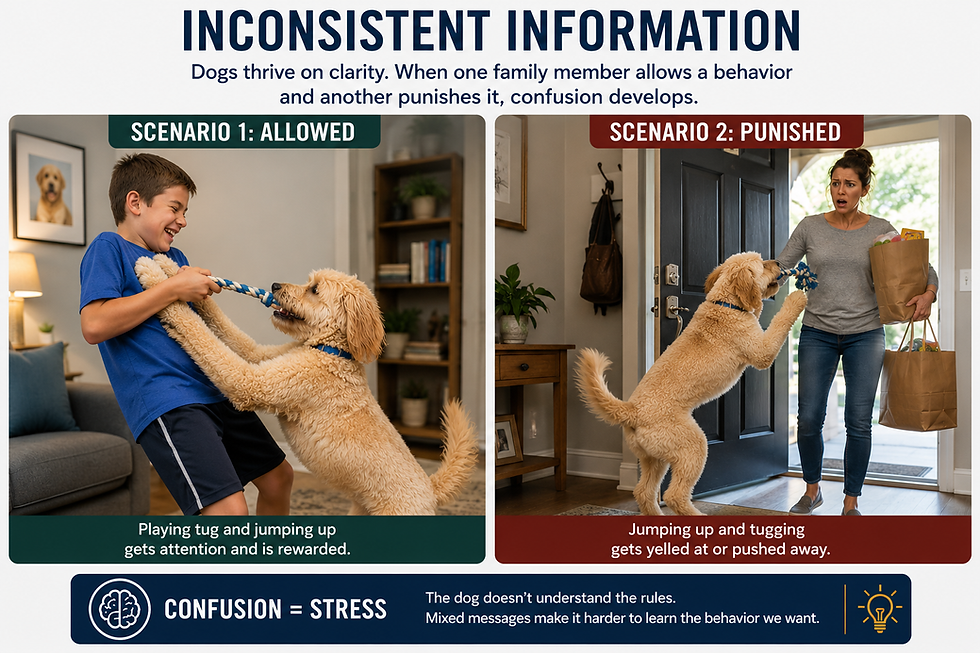
Inconsistent Information - Dogs thrive on clarity.
When one family member allows a behavior and another punishes it, confusion develops. Consistency creates learning. Inconsistency creates uncertainty.
Building New Neural Pathways
Changing behavior is not simply stopping something. It is creating a new option.
Every time we reinforce calm behavior, engagement, eye contact, impulse control, or thoughtful decision making, we are strengthening new neural pathways. We are literally helping the dog build a new pattern. The goal is to intervene before the dog is over threshold. You have had enough experience that you can predict and work with a dog:
Before the dog lunges. Before the dog explodes. Before the dog loses the ability to think.
When we consistently reinforce desirable choices at lower levels of arousal, the dog develops a larger behavioral toolbox. Over time the dog begins to pause. To think.
To look for information. To choose differently. That pause is where training lives.
Final Thoughts
Most behavior problems are not evidence of a bad dog. They are evidence of a dog responding to genetics, environment, learning history, nervous system state, physical needs, and previous reinforcement. When we stop asking, "How do I make my dog stop?" and begin asking,
"Why is this behavior happening and what would I like my dog to do instead?"
everything changes. Training becomes education. Behavior becomes communication.
And both dogs and humans become easier to understand.

Comments