
When Your Dog Won’t Stop Humping & Mounting A practical guide for owners who are frustrated—and a bit embarrassed

I recently worked with a client that got kicked out of daycare for humping and thought it was time to share. If you’ve gotten the call from daycare that your dog keeps mounting other dogs and is being removed from play, you’re not alone.
And more importantly—you’re not doing anything wrong.humping & mounting
This is one of the most common behavioral patterns seen in adolescent dogs, especially social, high-energy breeds like a Labrador Retriever. It feels uncomfortable because it’s happening in a public setting, but behaviorally, it’s very straightforward. What you’re seeing is not a personality flaw. It’s not dominance. It’s not a training failure. It’s a regulation issue. humping & mounting
What’s Actually Going On
Young dogs—especially around 6 to 12 months—are still developing:
Impulse control
Emotional regulation
The ability to disengage
Now place that dog into a daycare setting:
Multiple dogs
Constant movement
High excitement
No structured breaks
From a nervous system perspective, this is a lot.
When arousal rises faster than the dog can manage, the dog looks for an outlet. For many dogs, that outlet becomes mounting.
In simple terms:
The behavior is the result of being overwhelmed—not misbehavior.
Why Daycare Often Makes This Worse
Most daycare environments are not designed to teach regulation. They are designed for group management.
So the pattern usually looks like this:
Dog becomes overstimulated
Dog mounts
Dog is removed
What’s missing:
No early interruption
No redirection
No learning of an alternative behavior
The dog never practices staying regulated. It only practices escalating.
What You Can Do Instead
This is where things start to shift.
1. Reduce the Exposure (Temporarily)
This is not forever—but continuing the same environment will continue the same result.
Replace large group daycare with:
One or two calm, stable dogs
Short, structured interactions
The goal is to lower the intensity so your dog can actually learn.
2. Learn the Early Signs
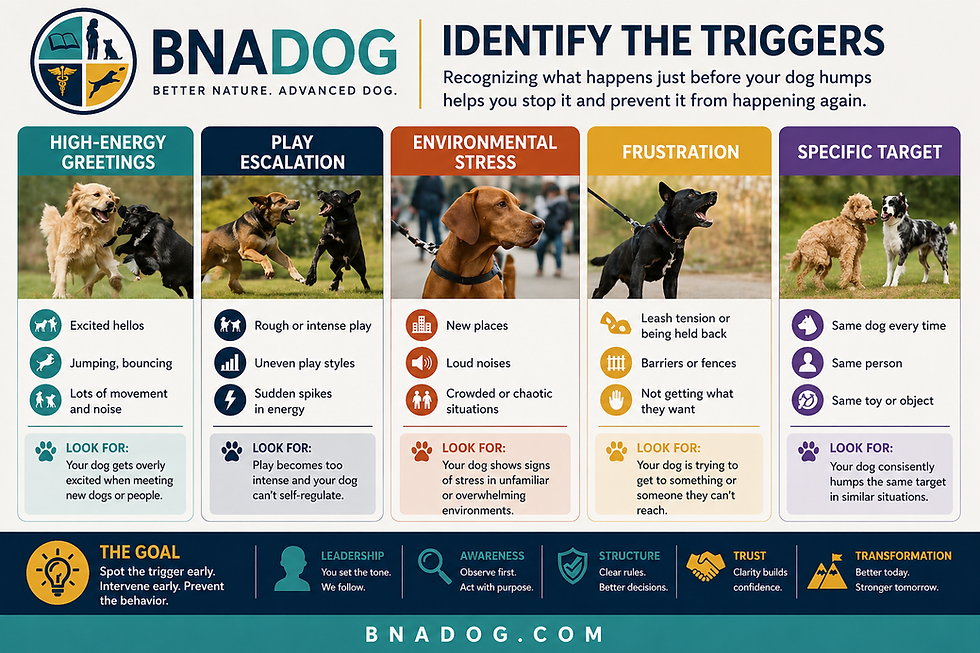
Humping doesn’t happen randomly—it’s triggered by overstimulation, stress, frustration, or repeated patterns your dog has learned over time. When you understand what happens right before the behavior, you can step in early and change the outcome.
This guide breaks down the most common triggers so you can recognize them in real time and prevent escalation before it starts.
A regulated dog makes better decisions.
#DogBehavior #DogTraining #StopDogHumping #DogTrainingTips #OverstimulatedDog #PuppyTraining #DogBehaviorHelp #ImpulseControl #CalmDog #CTDogTrainer #BNADOG
Mounting doesn’t come out of nowhere. It builds.
Watch for:
Faster, more erratic movement
Increased fixation on one dog
Jumping or bouncing that starts to lose rhythm
This is your moment to step in.
If you wait until the mount, you’re already late.
3. Interrupt Early and Calmly
No emotion, no correction tone.
Just:
Step in
Guide your dog away
Remove access to the other dog
Calm, consistent interruption is far more effective than reacting after the fact.
4. Redirect Immediately
Stopping the behavior isn’t enough. The dog needs something else to do.
Use:
A short, structured walk
A brief reset away from stimulation
A familiar behavior (stand, settle, or simple engagement)
This teaches:
“When things get intense, I move away and regulate.”
5. Reintroduce with Limits
Let your dog go back to interaction—but in shorter windows.
Interrupt again at the first sign of escalation.
This is how the dog learns to stay within a manageable range instead of tipping over.
6. Build Regulation Outside of Social Settings
This is the piece that makes everything else work.
Daily practice should include:
Controlled walking with changes in pace and direction
Pauses and stillness
Simple duration work (holding a position calmly)
You’re building the dog’s ability to stay regulated before adding complexity.
Other Reasons Dogs Mount
While overstimulation is the most common cause in daycare scenarios, mounting can also come from:
Stress or Uncertainty
New environments, social pressure, or too much exposure too quickly.
What helps:Reduce intensity, increase predictability, give the dog space.
Frustration
The dog wants access (to a dog, person, or object) and can’t get it.
What helps:Teach impulse control before allowing access.
Control-Based Behavior
The dog repeatedly targets one specific dog.
What helps:Remove access and reinforce neutral coexistence instead of interaction.
Habit
The dog has practiced the behavior enough that it happens automatically.
What helps:Consistent interruption + consistent replacement behavior.
The Pattern That Applies to All Dogs
Regardless of the cause, the solution follows the same structure:
Identify the state (overstimulated, stressed, frustrated, etc.)

Before you try to stop the behavior—understand the state. Mounting is not random. It’s a reflection of what your dog is experiencing internally in that moment. Whether your dog is overstimulated, stressed, trying to control the environment, or repeating a learned habit, the state determines the solution.
When you can identify what’s driving the behavior, you can step in earlier, respond more effectively, and actually change the pattern.
Calm, regulated dogs don’t need to escalate.
#DogBehavior #DogTraining #StopDogHumping #DogTrainingTips #OverstimulatedDog #DogAnxiety #ImpulseControl #CalmDog #CanineBehavior #BNADOG
Humping doesn’t happen randomly—it’s triggered by overstimulation, stress, frustration, or repeated patterns your dog has learned over time. When you understand what happens right before the behavior, you can step in early and change the outcome.
This guide breaks down the most common triggers so you can recognize them in real time and prevent escalation before it starts.
A regulated dog makes better decisions.
#DogBehavior #DogTraining #StopDogHumping #DogTrainingTips #OverstimulatedDog #PuppyTraining #DogBehaviorHelp #ImpulseControl #CalmDog #CTDogTrainer #BNADOG
Adjust the environment
Interrupt early
Redirect appropriately
Build a default behavior
Prevent repetition
That’s how behavior changes—consistently, not forcefully.
Final Thought
If your dog is struggling in daycare, it doesn’t mean they’re not social or that something is wrong with them.It means the environment is currently ahead of their ability to regulate within it. When you slow things down, add structure, and teach the dog how to come back to baseline, the behavior improves—and so does everything else. check out UCDAVIS
For the complete protocol email me at info@bnadog.com

Comments